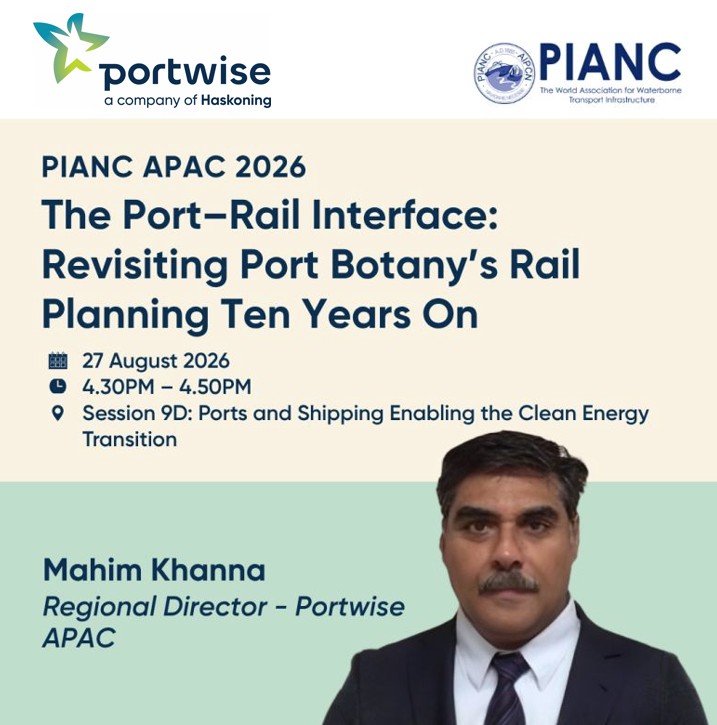
Ten years on: Portwise revisits Port Botany rail planning at PIANC APAC 2026
How well do long-term port plans stand up to reality?
That is the question Portwise Regional Director Mahim Khanna will explore at PIANC APAC 2026 in Brisbane, where he will revisit the rail planning undertaken by Portwise for Port Botany in 2015.
Australia’s port volumes continue to grow, but increasing throughput is only one part of the challenge. The ability to move freight efficiently to and from the port is just as important. Road and rail interfaces can become critical constraints on port capacity, operational performance and the wider freight network.
At PIANC APAC 2026, Mahim will look back at the assumptions, ambitions and recommendations behind the Port Botany rail planning work and compare them with what happened over the following decade.
What can we learn from a port plan ten years later?
Port planning is inherently long term. Decisions about infrastructure, capacity and freight connectivity are often made against forecasts that extend many years into the future. But volumes change. Supply chains change. Infrastructure programmes develop differently from expectations. Operational requirements evolve. That makes retrospective analysis valuable.
Rather than asking only whether a forecast was right or wrong, the more useful questions are:
- Which assumptions proved robust?
- Where did actual developments differ from the original vision?
- Which interventions delivered the expected benefits?
- What constraints emerged that were difficult to anticipate?
- What can other ports learn when planning their own road and rail interfaces?
Mahim’s presentation will use the Port Botany case to explore these questions and consider what the experience means for future port and freight planning.
Why the port-rail interface matters
A port does not operate in isolation.
Quay capacity, yard capacity and terminal productivity matter, but overall port performance also depends on how effectively cargo can enter and leave the port. Where road or rail interfaces cannot keep pace with terminal and trade growth, landside connectivity can become a limiting factor.
For port authorities and terminal operators, this means that long-term planning needs to look beyond individual assets. Infrastructure, operations, demand patterns and the wider freight network need to be considered together.
This is also why revisiting previous plans is useful. It creates an opportunity to compare modelling and planning assumptions with real operational developments, and to use that evidence to improve future decisions.
Meet Portwise at PIANC APAC 2026
Mahim Khanna will present “The Port-Rail Interface: Revisiting Port Botany’s Rail Planning Ten Years On” on Thursday 27 August from 3.30pm to 3.50pm, as part of Session 9C: Port Planning and Engineering at PIANC APAC 2026 in Brisbane.
PIANC APAC brings together port, maritime and infrastructure professionals from across Australia, New Zealand and the wider Asia-Pacific region to discuss topics including port planning, operations, technology, infrastructure and sustainability.
If you are attending the conference and are working on port capacity, freight connectivity, terminal planning or long-term infrastructure decisions, we would welcome the opportunity to exchange perspectives with Mahim in Brisbane.
Attending PIANC APAC 2026? Connect with Mahim Khanna to discuss the lessons from Port Botany and the challenges facing port and terminal development across the region.
Related Articles
- How does simultaneous charging of multiple vehicles impact terminal power infrastructure?
- What happens if berth operations are not properly planned?
- How does equipment duty cycle analysis inform electric vehicle selection for terminals?
- What cybersecurity risks exist in modern port management systems?
- How do you prepare terminal operations for full automation?