Emulation for container terminals: reducing implementation risk before go-live
Simulation remains essential, but it no longer removes enough implementation risk
Container terminals are under increasing pressure to deliver stable and predictable performance from the first vessel call onwards. Larger vessels, tighter operational margins and growing software dependency leave little room for uncertainty during implementation.
Simulation remains a critical part of terminal design. It helps operators evaluate layouts, equipment strategies, yard concepts and operational scenarios long before physical assets or software systems are deployed. For decades, this was often considered sufficient.
Today, it is not.
Many terminals achieve promising simulation results during design phases but still experience instability during go-live. Delays, bottlenecks and operational disruption frequently emerge once the Terminal Operating System (TOS), Equipment Control System (ECS), Fleet Management System (FMS) and automated equipment begin interacting under realistic operational pressure.
The challenge is no longer only whether the terminal concept works theoretically. The challenge is whether all operational systems continue to function reliably once the complexity of real operations begins. This is why more terminals are moving beyond simulation towards emulation.
Simulation versus emulation
Simulation helps terminals understand how an operation may perform over time. It supports strategic decision-making around capacity requirements, berth productivity, equipment sizing, yard performance, operational concepts and long-term expansion strategies.
Emulation introduces another level of operational realism. Instead of simulating all behaviour internally, emulation connects the actual operational software to a realistic digital terminal model. This can include the TOS, ECS, FMS and other operational control platforms.
The result is a near-to-live testing environment where terminals can validate how software systems behave before deployment.
Rather than evaluating assumptions alone, terminals can observe how real operational logic responds to traffic congestion, equipment disruption, communication delays, manual intervention, peak operational demand and exception handling scenarios.
This difference becomes increasingly important as automated terminals become more software-defined.
Why operational complexity creates new implementation risks
Modern automated terminals depend on continuous interaction between multiple systems and suppliers. Even when individual systems function correctly in isolation, integration problems often emerge once all operational layers begin interacting simultaneously.
For example, a relatively small delay in ECS task confirmation may create cascading scheduling conflicts that affect automated vehicle dispatching, crane sequencing and yard allocation decisions.
Similarly, traffic management logic that performs well under average operational conditions may become unstable once peak vessel demand, manual interventions and equipment disruption occur simultaneously.
These issues are difficult to identify in traditional simulation environments because systems often operate under ideal assumptions.
In reality, terminals continuously face operational exceptions.
The real challenge is not whether systems work under normal conditions. It is whether they recover safely and efficiently when operations become unpredictable.
Why late-stage testing often creates unnecessary pressure
Historically, many projects introduced emulation relatively late during implementation.
By that stage:
- Software configurations are already advanced
- Supplier dependencies are tightly connected
- Operational teams are under time pressure
- Commercial deadlines are approaching
- Live operational testing becomes increasingly risky
As a result, terminals often discover integration weaknesses when there is limited time left to resolve them properly. This creates avoidable commercial and operational pressure during go-live. Leading terminals are increasingly adopting a different approach.
Instead of treating simulation and emulation as separate project phases, they develop one evolving operational model that supports the entire project lifecycle. This improves consistency between design and implementation, strengthens validation of supplier assumptions, increases integration testing quality and supports stronger communication, go-live preparation and long-term operational readiness across the project lifecycle.
Emulation creates a safer environment for integration testing
Automation projects typically involve multiple suppliers, each delivering different software logic, control systems and operational assumptions. Even when every individual component passes factory testing, operational instability may still emerge once all systems begin interacting together. Emulation allows terminals to validate these interactions safely before live deployment.
Terminals can test system interfaces, equipment coordination logic, scheduler behaviour, exception recovery procedures, high-load operational scenarios and software updates or configuration changes before deployment. Importantly, scenarios can be repeated consistently.
This makes root cause analysis significantly easier than during live operations, where conditions constantly change and commercial pressure is high.
Beyond go-live: digital twins are becoming long-term operational assets
The value of emulation increasingly extends beyond implementation itself. More terminals are maintaining emulation environments as long-term digital twins that support future software upgrades, operational optimisation, equipment expansion planning, scenario analysis, staff training and continuous improvement initiatives. Rather than becoming obsolete after go-live, the operational model evolves into a long-term decision-support environment. This is particularly valuable as terminals become more dependent on software updates, automation upgrades and operational optimisation over time.
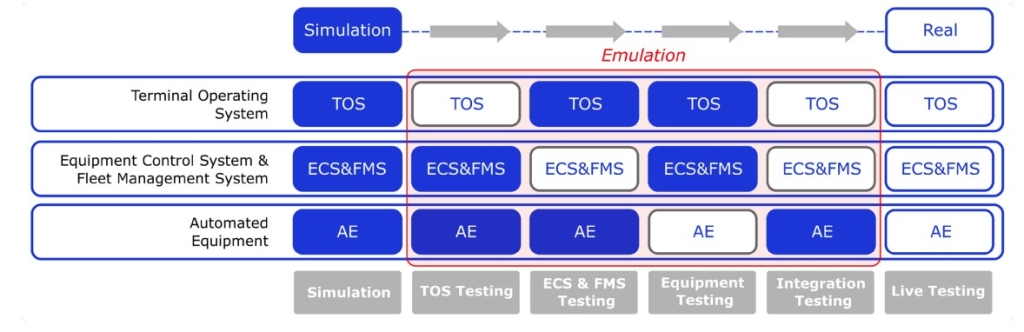
Figure: Simulation to emulation, showing individual components that can be exchanged for functional or performance testing.
A more reliable path towards automation
Simulation remains essential for strategic terminal design. However, simulation alone no longer provides enough certainty for highly interconnected automated operations. Emulation helps terminals validate how real systems behave under realistic operational pressure before live deployment begins. Together, simulation and emulation create a more reliable pathway from concept design to stable operations.
As terminals become increasingly software-defined, operational performance will depend less on individual equipment specifications and more on how effectively entire systems interact under operational pressure.
For terminal operators, reducing uncertainty before go-live is rapidly becoming a strategic advantage rather than a technical preference.
If you’re interested in learning more, reach out to learn about simulation and emulation.
This article was created with the support of AI tools based on Portwise content. Portwise accepts no responsibility for errors or decisions based on this information.
Related Articles
- What optical character recognition accuracy is needed for automated gate processing?
- Which factors determine schedule reliability in shipping?
- How do you plan charging infrastructure for port equipment?
- What challenges do port consultants help solve?
- How does container terminal planning integrate with hinterland logistics?